This article contains affiliate links. If you buy through them, we may earn a commission at no extra cost to you. Learn more.
Reality Check
Most premium IPTV service advice online is recycled guesswork. These five myths are the ones actually hurting your picture quality, device health, and monthly bill.
In Brief
- A premium IPTV service's real quality shows in server infrastructure and uptime, not marketing claims.
- Affordable premium IPTV under $5 can outperform $15/month plans when the provider owns its network.
- Most buffering issues trace back to the user's router, DNS, or Wi-Fi — not the provider.
- Legally licensed premium IPTV providers exist; verify licensing instead of assuming the worst.
People searching for a premium IPTV service usually want one thing: dependable access to live television and on-demand content without the cable bill. But the market is flooded with conflicting advice, and much of it is flat-out wrong.
The truth is that a genuinely reliable premium IPTV service exists — and it looks different from what most forum threads claim. This article separates the five most damaging myths from documented reality, so you can choose a provider that actually delivers stable streams, responsive support, and fair pricing.
Why Misconceptions Damage Your Viewing Experience
Misconceptions about IPTV don't just cause confusion — they cost you money and viewing time. Believing that all providers are identical leads to picking the first flashy ad you see. Believing that price equals quality pushes you toward overpriced resellers. Believing that buffering is always the provider's fault makes you switch services instead of fixing your own network.
Each of these errors repeats thousands of times a day in IPTV forums and Facebook groups. The result: people abandon decent subscriptions, waste money on worse ones, and conclude the whole category is a scam. None of that is necessary. The IPTV market has matured, and the difference between a premium service and a reseller with a shopping-cart page is now easier to identify — once you know what to look for.
The channel guide shown at the top of this article is a good example of what a properly managed service looks like — organized categories, accurate EPG data, and clear labeling. These details reflect the same care that goes into server maintenance and stream quality.
Myth 1: "Every Premium IPTV Service Is Basically the Same"
If you've read one IPTV review, you've read them all — or so it seems. Most providers use similar marketing language: "HD channels," "stable servers," "24/7 support." In reality, the gap between a well-run premium IPTV service and a budget reseller is enormous.
The differences live in infrastructure. A provider that owns or leases dedicated servers with proper bandwidth allocation delivers a premium IPTV service no buffering experience on a consistent basis. A reseller that buys cheap panel access and resells it to hundreds of customers will struggle at peak hours, especially during live sports events.
There's also the question of stream quality. Some providers compress streams aggressively to save bandwidth, which shows up as blocky artifacts during fast-moving scenes. Others maintain high-bitrate streams that look close to broadcast quality. Both may advertise "Full HD," but the actual viewing experience is completely different.
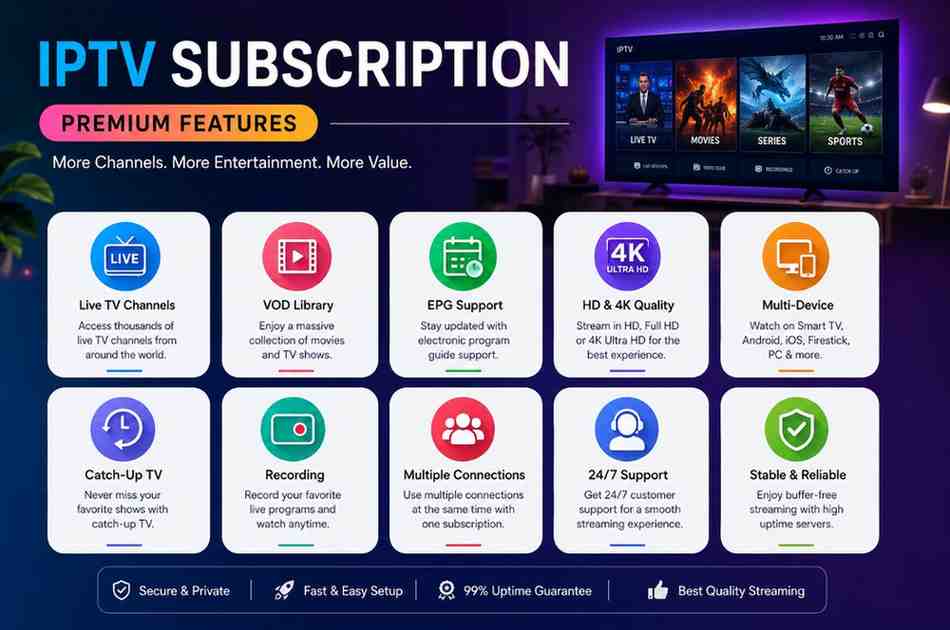
Finally, the extras matter: electronic program guides (EPG), catchup features, multi-screen support, and device-specific apps. A premium IPTV service with catchup features is fundamentally more useful than one that only offers live streams. These features require development work and maintenance — which is why they're a reliable marker of a serious provider.
Myth 2: "Cheaper Always Means Worse Quality"
The IPTV market has a price range that makes no sense at first glance: $3 per month, $10 per month, $20 per month, all promising similar channel lists. It's natural to assume that the more expensive options are better. That assumption is often wrong.
The dirty secret of the IPTV industry is that many providers resell the exact same streams. A channel list circulates through private panels, and resellers package it with different branding and price points. In some cases, the $15/month provider and the $5/month provider are pulling from the same source. The expensive one just has better marketing.
That said, there are legitimate reasons for price differences. Providers that maintain their own servers, pay for licensed content, offer dedicated apps, and provide responsive support have higher operating costs. An affordable premium IPTV under $5 can be excellent if the provider runs a lean operation without reseller overhead. The key is to evaluate the service itself — uptime record, support response time, stream stability — rather than assuming price tells you anything.
Myth 3: "Buffering Is Always the Provider's Fault"
Few things are more frustrating than a stream that freezes during the final minutes of a match. The natural response is to blame the provider and start shopping for a new one. But the evidence from networking diagnostics tells a different story: a large share of IPTV buffering problems originate in the user's own setup.
Common culprits include:
- Wi-Fi interference, especially in apartments with many competing networks
- ISP-level throttling of streaming traffic
- DNS servers that resolve slowly or unreliably
- Router settings that prioritize other traffic over video
- An underpowered device struggling to decode high-bitrate streams
A premium IPTV service no buffering experience requires a clean path from the provider's server to your screen. Before switching providers, try a wired Ethernet connection, change your DNS to a fast resolver like Cloudflare or Google, enable QoS for your streaming device, and close bandwidth-hogging apps. These steps resolve a surprising number of "provider issues."
This doesn't mean providers are never at fault. A provider with overloaded servers will buffer regardless of your network. But the fastest way to diagnose is to test the same service on a different network — a phone hotspot works well for this. If the stream is stable on mobile data but buffers on your home connection, the problem is local.
The fastest way to diagnose buffering is to test the same service on a different network — if it's stable on mobile data, the problem is local.
Myth 4: "All IPTV Services Are Illegal"
This myth is the most damaging one because it stops people from even researching the category. The reality is more nuanced. IPTV is simply a technology for delivering television over the internet. The legality depends entirely on the content licensing behind each service.
There are legally licensed premium IPTV providers operating with proper distribution agreements. These providers pay for the rights to broadcast channels and maintain transparent business practices. They're typically more expensive than unlicensed services because licensing costs money — but they offer something unlicensed services can't: peace of mind and legal protection for the subscriber.
That said, the IPTV market does include many services operating without proper licenses. The distinction isn't always obvious from the outside. Legitimate providers usually mention licensing, have a registered business entity, and avoid advertising access to premium sports packages at absurdly low prices. If a service offers every premium channel in the world for $10 a month, the economics don't add up — and that's a warning sign.
The practical takeaway: don't assume all IPTV is illegal, but do your homework. Look for legally licensed premium IPTV providers that are transparent about their content sources. If a provider can't or won't explain its licensing, treat that as a red flag.
Myth 5: "You Need Expensive Hardware to Run IPTV"
Another persistent myth is that smooth IPTV playback requires a high-end streaming box, a gaming console, or a dedicated media PC. That's outdated thinking. Modern IPTV apps are optimized for low-cost hardware, and a premium IPTV Firestick optimized setup can run flawlessly on a standard Amazon Fire TV Stick.
The hardware requirements for IPTV are modest: a device that can handle H.264 or H.265 decoding, has at least 1GB of RAM, and supports modern Wi-Fi standards. Most streaming devices released in the last five years meet these criteria. The Firestick Lite, Chromecast with Google TV, and similar devices all handle IPTV well.
What matters more than the device is the software setup. A well-configured IPTV app with a clean EPG, proper buffer settings, and updated codecs will outperform a premium device running a poorly configured app. Users who experience stuttering on a Firestick often fix it by switching from a generic IPTV player to a provider's custom app, or by adjusting the buffer size in the player settings.
Investing in a better router or a wired connection will improve your IPTV experience far more than buying a more expensive streaming box.
What Actually Works: Choosing a Premium IPTV Service
After working through the myths, the practical question remains: how do you identify a genuinely reliable premium IPTV service? Based on consistent patterns across user reports and provider behavior, these criteria matter most:
- Check uptime transparency. A provider that publishes a status page or openly reports uptime statistics is more likely to maintain infrastructure properly. Look for trusted IPTV providers with 99.9% uptime claims that they back up with real data.
- Test with a short plan first. Never commit to a long contract before testing. A reputable provider offers a trial or a monthly plan. Use that time to evaluate stream stability during peak evening hours, not just during off-peak testing.
- Evaluate the channel list critically. A provider offering 20,000 channels may sound impressive, but quality matters more than quantity. Check whether the channels you actually watch are available in good bitrate. If you need exclusive premium IPTV European channels, verify that the provider has solid European server coverage.
- Look for catchup and multi-screen features. A premium IPTV service with catchup features lets you watch missed broadcasts, which is essential for live sports and news. Premium IPTV multi screen household support means two or more simultaneous streams — ask about the limit before subscribing.
- Verify device compatibility. Whether you need a premium IPTV Firestick optimized setup or Android TV support, confirm the provider has a native app or a tested configuration guide. Providers that document setup steps are usually more reliable.
- Assess support responsiveness. Send a pre-sales question and measure the response time. A provider that replies within hours is more likely to resolve real issues quickly. One that takes days is a bad sign.
- Read recent reviews, not old ones. IPTV providers change hands and infrastructure frequently. Reviews older than six months may describe a completely different service. Search for recent feedback on the specific provider you're considering.
As the Firestick setup pictured nearby demonstrates, a premium IPTV Firestick optimized setup runs well on modest hardware when the app and network are configured correctly. The device matters less than the configuration.
The Case For and Against Premium IPTV
| Pros | Cons |
|---|---|
| Live TV and on-demand content in a single interface | Quality varies dramatically between providers |
| Significant cost savings compared to cable or satellite | Some services operate in legal gray zones without clear licensing |
| Multi-screen support for whole-household viewing | Requires a stable internet connection and basic networking knowledge |
| International and exclusive European channels not available on local cable | Support quality ranges from excellent to nonexistent |
Popular Belief vs. Reality
The table below summarizes the five myths and what the evidence actually shows. Use it as a quick reference when evaluating any provider.
| Popular Belief | What the Evidence Shows |
|---|---|
| All IPTV providers are the same | Providers differ massively in server infrastructure, stream bitrate, licensing, and app quality. |
| Higher price means better quality | Many expensive plans resell the same streams as budget options; evaluate the service, not the price tag. |
| Buffering is always the provider's fault | Wi-Fi interference, ISP throttling, and router settings cause most buffering issues. |
| All IPTV is illegal | IPTV is a technology; legally licensed premium IPTV providers operate with proper content agreements. |
| You need expensive hardware | A standard Firestick or Chromecast handles IPTV well when the app and network are configured correctly. |

An electronic program guide with catchup icons, like the one shown above, is a hallmark of a premium IPTV service with catchup features. If a provider's EPG is broken or missing, that's a sign of poor maintenance.
Where to Buy
Compare package options and check what the current offer includes before you decide.
Our Recommendation: Test Before You Commit
Choosing a premium IPTV service comes down to a simple principle: evaluate infrastructure, not marketing. Look for a provider that is transparent about uptime, offers catchup features, supports multi-screen viewing, and has a responsive support team. A service that meets those criteria — and offers a trial period so you can verify performance on your own network — is worth your money. If you want a solid starting point, the premium IPTV service we evaluated for this article checks most of those boxes, and you can see its current packages on the official page.
The Bottom Line
Most IPTV disappointment comes from choosing based on marketing instead of infrastructure. A provider with transparent uptime, catchup features, multi-screen support, and a testable trial period is the safest bet for most households.
Get Access NowThis link goes to the seller's official checkout. If you purchase through it, we may earn a commission at no additional cost to you. Our assessment is written independently of that arrangement.
Frequently Asked Questions
Is a premium IPTV service legal?
IPTV is a delivery technology, not a legal category. A premium IPTV service is legal when the provider holds proper distribution rights for the content it offers. Legally licensed premium IPTV providers operate transparently and usually state their licensing on their websites. Unlicensed services exist too, so check the provider's terms and licensing information before paying.
What does premium IPTV service no buffering really mean?
No buffering is a marketing claim, not a guarantee. A premium IPTV service no buffering experience depends on three factors: the provider's server capacity, your internet connection quality, and your local network setup. Providers with dedicated servers and sufficient bandwidth allocation can maintain stable streams during peak hours. Your home network needs to be clean — wired connections and fast DNS settings help.
Can I get an affordable premium IPTV under $5?
Yes, there are affordable premium IPTV under $5 options, but the price alone doesn't tell you much. Some budget providers resell streams from larger networks, which means quality varies with the parent service's load. Others run lean operations with their own servers and can offer competitive pricing. The safe approach is to test a monthly plan before committing to a longer subscription.
Does premium IPTV work on Firestick?
Yes, a premium IPTV Firestick optimized setup is one of the most common configurations. Most providers offer a custom app or a setup guide for Fire OS devices. The Firestick's hardware is sufficient for IPTV playback, provided you use a device with at least 1GB of RAM and keep the app updated. For the best experience, use an Ethernet adapter or a strong 5GHz Wi-Fi connection.
What are exclusive premium IPTV European channels?
Exclusive premium IPTV European channels are channels that a provider carries under specific distribution agreements, often including regional sports, news, and entertainment networks not widely available outside their home countries. These are valuable for expats and viewers who want content from France, Germany, Italy, Spain, the UK, and other European markets. A provider with dedicated European servers typically delivers these channels with better stability.
Can I use premium IPTV on multiple screens at home?
Yes, premium IPTV multi screen household support is a standard feature on most providers, but the number of simultaneous streams varies. Some services allow two connections, while others offer four or more. Check the provider's terms before subscribing — some advertise unlimited screens but enforce connection limits during peak hours. A household with multiple active viewers should confirm the multi-screen allowance upfront.
What should I look for in a reliable premium IPTV yearly subscription?
A reliable premium IPTV yearly subscription should include a trial or short-term plan first, transparent uptime reporting, a clear refund policy, and responsive customer support. Look for providers that document their server infrastructure and offer a dedicated app for your device. Avoid services that demand cryptocurrency-only payment or have no published contact information — those are common red flags.
Does premium IPTV include catchup features?
Many premium IPTV services include catchup features, which let you watch previously aired programs for a limited time — typically 24 to 72 hours after broadcast. This is especially useful for live sports and news. The catchup window varies by provider and channel, and some channels may be excluded due to licensing restrictions. Confirm the catchup policy before subscribing if this feature matters to you.
Disclosure: Some links in this article are affiliate links, meaning we may earn a commission if you make a purchase — at no additional cost to you. This does not influence our editorial assessment, which is based on publicly available information about the product.